
Biotechnology for a circular nutrient economy.
Spinitek harvests invasive aquatic biomass to remove nitrogen and phosphorus from waterways — and converts what we capture into biostimulants and biopellets that feed soil and crops.
Closing the loop on the world's most leaked nutrient.
Every year, more reactive nitrogen escapes from agriculture into rivers, lakes and atmosphere than the planet can safely absorb. The result is dead zones, toxic algal blooms and rising emissions.
We see that pollution as a misplaced resource. Our biological process extracts it, stabilises it, and returns it to the soil — where it belongs.
Excess nutrients are suffocating the world's waterways.
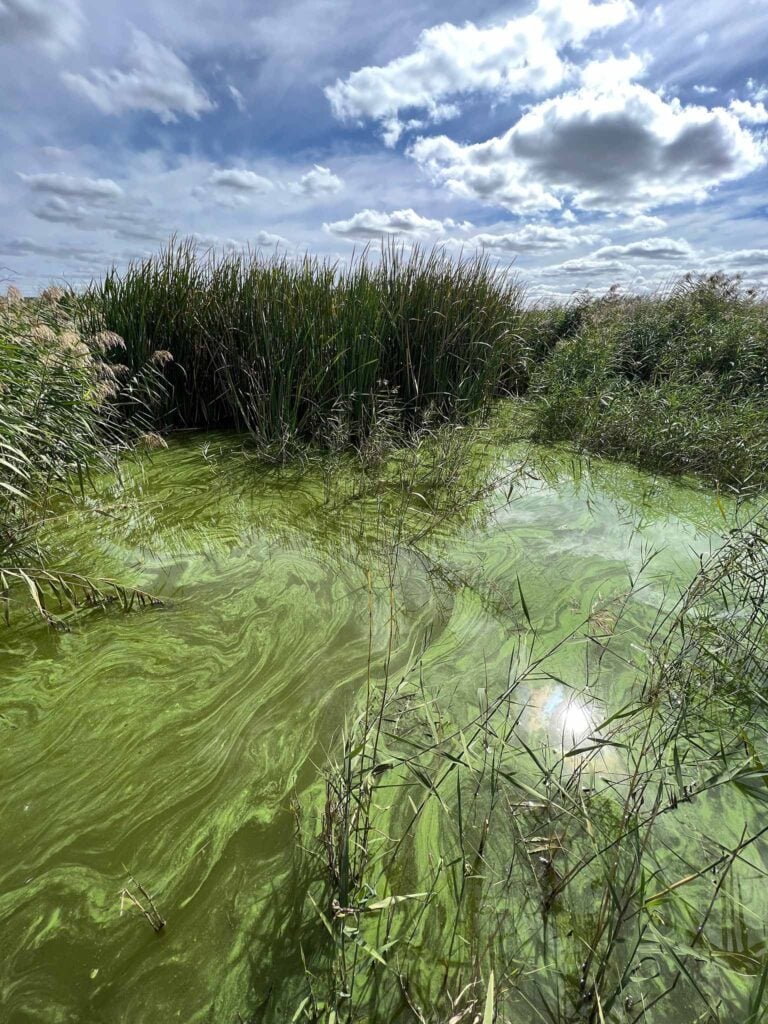
Nitrogen and phosphorus runoff from agriculture and wastewater feeds explosive algal growth. As the algae die and decompose, they strip oxygen from the water, killing fish and releasing methane.
A circular biological pipeline — from waterway to working soil.
Each stage is engineered to be net-positive: removing pollution while creating an input that farmers actually want.
Phytoremediation
Phragmites reeds and other aquatic macrophytes draw excess nitrogen and phosphorus out of contaminated water at remarkable rates.
Microbial Process
Harvested biomass enters our proprietary fermentation, where microbial communities stabilise nutrients and unlock plant-available compounds.
Biostimulant
The output: a liquid biostimulant that boost crop yield and rebuild soil organic matter.
Mighty green · Mighty good
Our flagship product line. PhragMighty turns harvested Phragmites reeds — an invasive species choking Australian wetlands — into a high-performance biostimulant for legume crops and improved pasture.
- Boosts microbial soil health
- Reduces synthetic N demand
- Improves water-holding capacity
- 100% Australian biomass

One catchment, seventy years apart.
Lake Wyangan, near Griffith NSW, is a textbook eutrophication case. Decades of agricultural runoff have shifted it from a clear recreational lake to a recurring algal bloom hotspot.


A single process, four compounding benefits.
Turns invasive biomass into productive inputs
Phragmites and other macrophytes that would otherwise be burned, dumped or left to decompose become a feedstock for soil renewal.
Captures carbon before it escapes to atmosphere
Decomposing aquatic vegetation is a major methane source. Harvesting and processing it short-circuits that emission pathway.
Lifts yield while rebuilding soil microbiology
Trial growers report stronger early vigour, improved root mass and reduced reliance on synthetic fertilisers.
Measurably reduces N and P loads downstream
Each tonne of biomass we extract removes kilograms of nitrogen and phosphorus from the water column.

Infrastructure for biological inputs — not a single product.
PhragMighty is the first commercial output of a fermentation-native platform designed for real farm conditions: diverse living microbial consortia, produced at pilot scale, in a concentrated payload that runs through existing spray equipment.
Engineered for low-capex scale-out, not high-capital scale-up — beginning with legumes and pasture, expanding into broadacre.
- 1,000 L pilot reactors operational
- Multi-crop field trials completed
- Manufacturing pathways validated
- Pipeline of concentrated SKUs
Founded in 2021. Built on Country.
Spinitek was founded in regional New South Wales by a small team of agricultural scientists, growers and engineers who saw two problems converging: too many nutrients in our waterways, and not enough biological inputs in our paddocks.
We work in close partnership with Charles Sturt University, growers across the Riverina, and water authorities to ground our R&D in real catchments and real farms.


“We trialled PhragMighty biostimulant from Spinitek in our 2023 seed onion crop. The crop experienced significant production challenges during the season, and existing management programs were both costly and labour intensive. Following a single application of PhragMighty, crop performance met and exceeded our expectations, with our lowest-yielding block achieving benchmark yields for the season. Based on these results, we ordered PhragMighty again for our 2024 season.”